get moving
AKA "real" damage...
Pain is tricky, and the fear of making it worse stops many from healing.
We help clients past this mental barrier by educating them on the different TYPES of pain, what causes them, and how they need to approach each one to ensure continued gain of function.
Today we're looking at nociceptive pain, aka "mechanical pain."
As we looked at last time, neuropathic pain aka "nerve pain" can be insidious because it changes the way you perceive pain and often prevents people from resolving the DEEPER pain that initially led to it, which was your nociceptive pain.
Nociceptive pain happens during acute injury. When you sprain an ankle, break a bone, tear a tendon, strain a ligament, etc. - that's nociceptive pain. It doesn't "come and go" like neuropathic pain often does. This pain is sharp, intense, and immediate.
Thankfully, the early phase of acute nociceptive pain reduction happens more or less automatically.
The body brings inflammation, white blood cells, and other emergency tools to the area, while triggering enough neuropathic pain to force you into deloading the involved area, aka "stop using it."
Through this process, initial nociceptive pain is typically resolved within hours or days, at most.
After that we have physical therapy/physio, which is the gradual reintroduction of loading to the involved joint to begin reducing neuropathic pain, correct compensations that set in during the initial recovery, and begin the long-term process of joint remodeling, which means fully repairing damaged collagen fibers while laying down new ones that work as well or better than what was damaged.
Unfortunately, what most people don't know is that remodeling takes much longer than typical PT programs, which are only 6-8 weeks on average, and are only meant to help you restore basic function.
It's often a several months to years-long process to fully remodel a joint, depending on how traumatic the injury was (or how invasive the surgery).
This is what screws people up after they're released from PT, because even though their nociceptive PAIN is gone or sharply reduced, the DAMAGE to mechanical tissues is only partially resolved, which means if they don't continue to train, their lingering compensations and imbalances will eventually cause new issues or simply recreate the old issues again. This leads many to believe they've done something wrong, or that PT wasn't effective, or some other misguided belief.
This only leads to new guarding behaviors and loss of function, especially if you just try to ignore the pain and "play through it" and end up with a new injury.
The bottom line is that you must continue loading mechanical tissues long after initial nociceptive pain has resolved, despite the continued presence of fluctuating neuropathic pain.
Neuropathic pain exists, in part, to alert you to loading limits that may trigger nociceptive pain aka "real damage."
It's your guide, when you understand it
Credit: Veritas Health
So long as you continue to load intelligently (and move slowly while you do it), you can always find the border where neuropathic pain starts giving way to nociceptive pain, then back off a bit, and feel the body to adapt to the position, over and over, until neither pain is present in the movement pattern through its entire range.
As you do this, you'll find your attitude and perspective towards pain begins to shift as well.
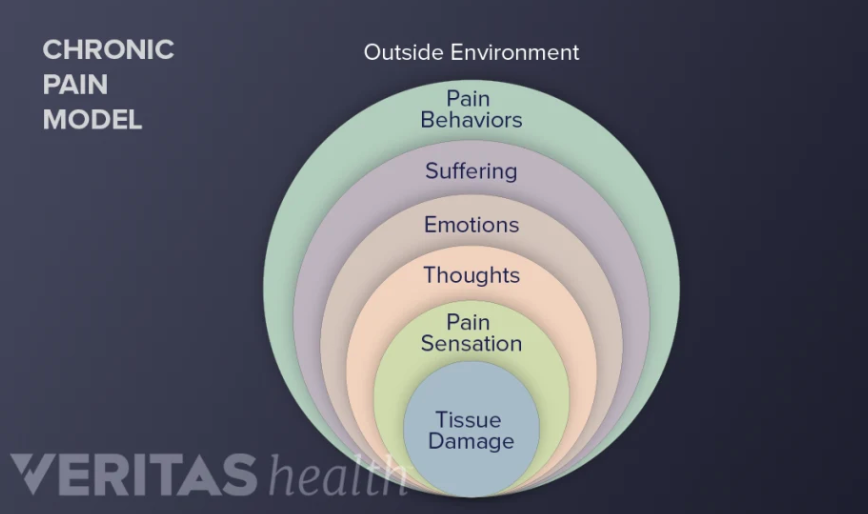
That dimension of felt experience, which is heavily influenced by our thoughts and emotions, is what we call 'centralized pain', and will be the topic of next week's email. Stay tuned!
-Coach Seanobi, BS, CSCS, CEP, CPT
P.S. - Whenever you’re ready, here are two ways I can help you:
1) FREE Movement Strategy Call
Sick and tired of joint pain keeping you from your favorite movements? You’re likely closer to the solution than you think IF you can make some key changes to your lifestyle and training. You know who can help you do that faster than anyone? A coach who's been there. Book a free consultation with me and let's chart the path forward together. Click here to schedule now.
2) Join The Joint Repair Forum. Our Facebook Group for individuals to learn, share, and collaborate on all things Joint Repair. Ask me a question and I'll ACTUALLY ANSWER IT. Join today!